What KYB software does for factoring
Business verification sits at the center of risk management for invoice factoring and commercial lending. When you advance against receivables, you are extending credit to businesses that are often thin-file, newly formed, or operating behind complex ownership structures. KYB software (Know Your Business) confirms an applicant is real, active, and who it claims to be before you commit capital.
The pressure is speed without blind spots. Data quality is now a measurable bottleneck: a 2025 enterprise survey found that 84% of organizations struggle with accurate identity data in verification workflows. When data is incomplete or stale, your team burns hours cleaning records instead of assessing risk, which drives up acquisition costs and loses deals to slower decisions.
Automated business verification replaces manual Google searches and one-off Secretary of State lookups with a process that is fast, repeatable, and defensible. That shift turns verification from a reactive control into a tool for selecting better clients.
Why manual verification breaks at volume
For high-volume firms, hand-checking every applicant is the constraint that slows everything downstream. It inflates labor cost, introduces inconsistency between analysts, and makes the fast funding turnaround your customers expect harder to deliver.
Robust KYB also keeps you off the wrong side of a fraud loss. Skipping verification exposes you to onboarding shell companies or entities linked to bad actors, which invites both write-offs and regulatory scrutiny. For factors that draw on bank funding lines, documented business verification is often a condition of the partnership, not an optional nicety.
What strong KYB software verifies
- Existence and status — confirm the business is registered, active, and matches the details on the application
- Ownership and control — validate beneficial owners, signers, and the corporate structure behind the entity
- Fraud and sanctions exposure — screen for red flags, watchlist hits, and synthetic-identity signals
- Entity linkage — surface relationships between the business and its principals that a single lookup would miss
Modern verification engines draw on large commercial and public data networks, and the strongest providers are recognized leaders in digital identity — independent analysts including Juniper Research and IDC ranked LexisNexis Risk Solutions at the top of identity verification in 2025. The point for a factor is not the vendor logo. It is that real-time entity resolution lets you assess an applicant in minutes instead of days, and embed the check directly into onboarding.
The compliance case: KYB, KYC, and CDD
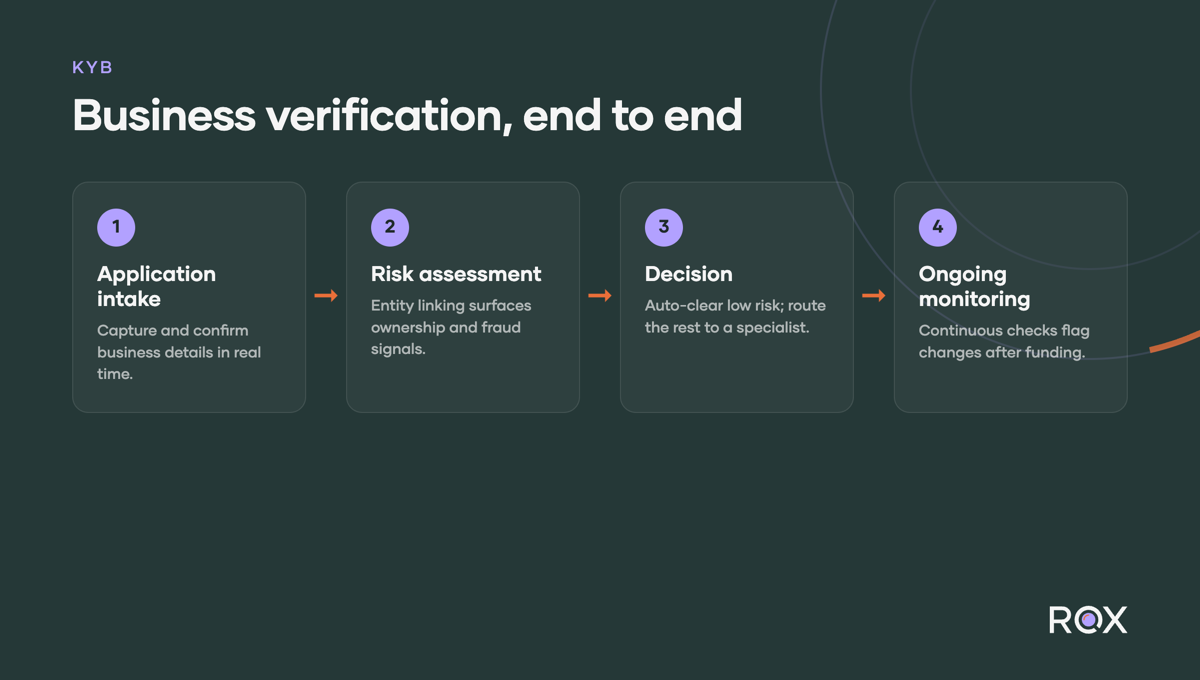
Invoice factoring firms face the same expectations as other financial institutions: know who you are doing business with. Modern KYB and KYC frameworks require you to verify the customer, identify ultimate beneficial owners (UBOs), and apply risk-based monitoring to higher-risk relationships as part of customer due diligence (CDD).
| Onboarding stage | Verification activity | What KYB software contributes |
|---|---|---|
| Application intake | Capture and confirm business details | Real-time validation of business identity and status |
| Risk assessment | Evaluate fraud and ownership risk | Entity linking surfaces relationships and red flags |
| Decisioning | Approve, refer, or decline | Configurable rules auto-clear low-risk, route the rest |
| Ongoing review | Monitor active accounts | Continuous checks flag changes after funding |
Automated workflows let you clear low-risk customers without manual touch and route only ambiguous cases to a specialist. When verification data lives alongside credit data, you can align KYB thresholds with your credit risk rules and judge financial strength and regulatory risk on one screen.
Build for disputes and audit trails
No data source is perfect, and applicants sometimes contest results. The practical takeaway is not to avoid third-party verification — it is to pair it with a process. Keep internal playbooks for handling data disputes, maintain audit logs of every verification result and manual override, and understand how your provider resolves inquiries. If a customer insists their business is legitimate despite a near-empty digital footprint, your team needs a defined path for that conversation rather than an improvised one.
How ROX fits the verification layer
The industry is consolidating around integrated workbenches rather than a dozen disconnected tools. ROX focuses on that integration layer: we bring third-party business verification data, credit risk signals, bank monitoring, and underwriting workflows into a single view, so a KYB result sits next to the credit decision instead of in a separate tab.
A practical pattern works well. Use a strong verification engine as the backbone of your check, then surround it with sanctions screening and UCC filings inside one platform. Define risk-based KYB tiers with matching rule sets, route verification outputs into the same workbench your analysts already use, and train the team to read the results consistently.
Measure what verification buys you
To turn compliance into an advantage, measure it. Track time-to-decision, the share of applications that need manual review, and the rate of approved accounts that later turn problematic. Teams that invest in cleaner data and tighter workflows see faster onboarding, which lets sales promise credible timelines instead of vague ones.
The bottom line
KYB and KYC expectations are rising while fraud tactics keep evolving. Automated business verification gives factors a faster, more defensible way to decide who to fund — speed without sacrificing compliance. The opportunity is to bring verification, credit, and underwriting together so you see the whole picture at the moment of decision.
See how ROX verifies businesses at onboarding. Get started free with three free applications. No card, no demo required.
References
- Melissa Survey: 84% of Enterprises Struggle with Data Quality in Identity Verification
- KYB (Know Your Business) Verification Guide 2025 — Sumsub
- Compliance Rules & Regulations: KYC and CDD Requirements — LexisNexis
- LexisNexis Risk Solutions Ranked #1 by Juniper Research for Digital ID and Verification
- LexisNexis Positioned as a Leader in IDC MarketScape Worldwide Identity Verification
- AI-Powered KYB Solutions for Streamlined Business Verification — AiPrise