What insurance underwriting automation actually means
Insurance underwriting automation is the use of AI, machine learning, and integrated software to handle the repetitive parts of underwriting — data extraction, document processing, compliance verification, and risk triage — so underwriters spend their time on judgment instead of data entry. It is not about replacing people. It is about building a workflow where your people stop doing robot work.
The gap it closes is large. Industry research finds that manual processes consume 30-40% of underwriter time, with professionals toggling between 6-10 disconnected systems a day. That fragmentation produces siloed data, errors, slow turnarounds, and lost deals. The persistent "inbox underwriting" model — emails, PDFs, and spreadsheets — wastes roughly a quarter of an underwriter's effort on deals that never bind.
The question for 2026 is no longer whether to modernize. It is how quickly you can do it without breaking your current operation.
AI moves from decision support to intelligent triage
Modern insurance underwriting software treats AI as a decision-support layer, not an autopilot. It ingests large datasets, surfaces risk factors automatically, and flags complex files for human review. Instead of an underwriter spending two hours gathering data, they spend fifteen minutes evaluating the risk. The system does the grunt work. The underwriter makes the call.
OCR and natural language processing have matured to the point where they reliably pull structured data out of unstructured documents. Generative AI and small language models now handle insurance-specific tasks well enough to cut claims processing time by up to 40%. Real-time decisioning lets you auto-approve clean risks and route the rest to people.
The ROI is measurable when the foundation is clean. Disciplined adopters report 10-20% sales conversion gains, 10-15% premium growth, and 20-40% reductions in onboarding cost. Success depends on standardized processes and quality data first — AI built on messy inputs produces confident, wrong answers.
Speed and compliance, side by side
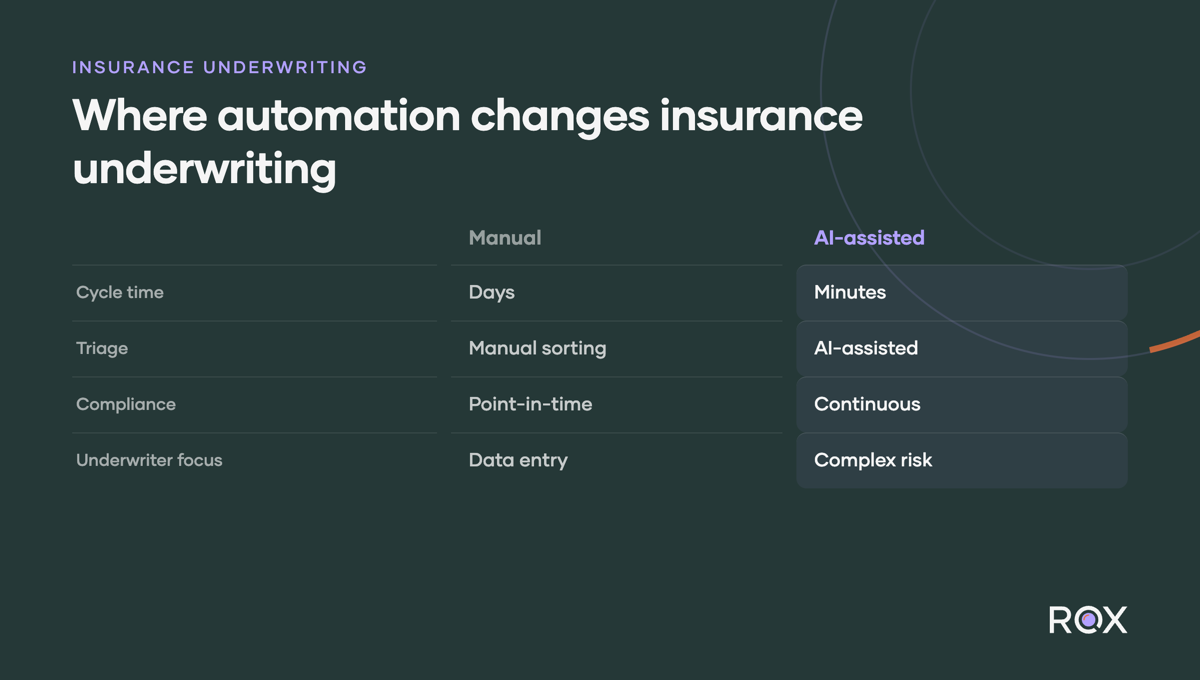
| Capability | Manual / Legacy Workflow | Automated Underwriting |
|---|---|---|
| Application turnaround | Days | Hours |
| Underwriter time on data entry | 30-40% | Minimal |
| Systems in daily use | 6-10 disconnected | One unified workbench |
| Audit trail | Reconstructed after the fact | Captured automatically |
| Risk triage | Reactive, manual | Real-time, AI-assisted |
The two goals reinforce each other. A unified workbench that consolidates the applicant, the risk data, and the decision tools into one view does more than speed up quote-to-bind cycles. It produces the audit trail regulators expect, without anyone keying it in twice.
The regulatory reality you cannot skip
Scrutiny on AI in underwriting is intensifying. The NAIC Model AI Bulletin, adopted across 19 states, mandates governance, transparency, and vendor oversight. States including New York, California, and Colorado have set their own precedents, and market conduct exams now probe how AI-driven decisions get made.
Explainability, documented processes, and SOC 2 compliance are no longer optional. Regulators want to see your work — and "the model decided" is not an answer that survives an exam. Pairing AI with clear accountability turns compliance from a tax into an advantage: the same governance that satisfies an examiner also builds broker and customer trust.
Why adoption still lags
If the technology is this good, why is the switch slow? Swiss Re identifies five familiar barriers: cost, time, IT complexity, scalability, and fear. Legacy data structures and decades-old core systems make rip-and-replace daunting, so many carriers layer orchestration on top rather than tearing everything out.
The practical path is incremental. Start with the basics — data, processes, systems — before bolting on AI. Pilot on a narrow risk class, measure risk selection and pricing accuracy, then scale what works. Better data feeds better models, which sharpen pricing, which generates better data. That loop is the real engine.
The competitive stakes
Underwriting used to be a back-office black box. It is now a front-office differentiator. Give a broker a fast, clear decision and they send you more business. Go silent for three days and they go to your competitor. Forrester expects customer experience and high-risk market strategy to separate the 2026 winners from the rest, and you cannot run either on spreadsheets.
ROX brings this same consolidation to factors and lenders — pulling credit data, background checks, UCC activity, and underwriting workflows into a single platform so the decision and the data live in one place. Our automated underwriting platform scores applications at the door and keeps the audit trail intact, so you move faster without breaking what works.
See how ROX automates underwriting. Get started free with three free applications. No card, no demo required.
References
- The future of AI for the insurance industry — McKinsey
- Insurance Technology Trends — Deloitte
- Key Underwriting Challenges — Diceus
- 5 Barriers to Underwriting Automation — Swiss Re
- When Algorithms Underwrite: Insurance Regulators Demanding Explainable AI — Buchanan Ingersoll & Rooney
- Insurance Predictions for 2026 — Forrester