What AI underwriting really means in 2026
AI underwriting is the use of machine learning and automated decision rules to gather borrower data, score risk, and route approvals in seconds instead of days. The pilot era is over. By 2026, more than 70% of community financial institutions will deploy AI-powered risk models, which sets a new baseline for how credit decisions get made. The payoff is concrete: early adopters report up to 40% faster approvals and 25% fewer compliance exceptions.
The tension is just as concrete. You need automation to compete on speed, but regulators are scrutinizing exactly how those fast decisions get made. The systems that promise the quickest answers draw the closest review. The good news is that speed and governance are not opposites. The lenders that solve compliance first are the ones that move fastest, because they are not stuck in legal review while competitors ship.
The regulatory wake-up call
The rules have hardened. The NAIC Model Bulletin on AI governance has been adopted in nearly 25 states, moving AI oversight from optional guidance to baseline expectation. On the lending side, the CFPB focuses on outcomes, not intent: if your model produces disparate impact, you are liable whether or not bias was deliberate. State enforcers are not waiting for federal action either. A $2.5M settlement from the Massachusetts Attorney General over an AI underwriting model set a clear precedent that you must test your automated models, document your algorithms, and monitor every decision.
Treating fair lending as a final checkbox is now a serious liability. Compliance has to be embedded in the workflow, not stapled on at the end.
The glass box imperative
Regulators want the "why" to be as visible as the "what." If you cannot explain precisely how a model reached a pricing decision or a denial, you cannot defensibly use it. That effectively kills black-box AI in underwriting.
What replaces it is the glass box: systems that document their logic, log decision pathways, and generate an audit trail for every output. This is not only a compliance burden. As AI-related errors-and-omissions claims rise, a demonstrably fair, auditable process becomes your strongest defense. Practical fairness work means auditing training data for representation, testing for disparate impact before deployment, and running continuous fairness checks afterward. Roughly 70% of large enterprises are already investing in these controls.
Speed without losing the thread
The biggest benefit of AI underwriting is instant decisioning, and it is safe only when three mechanisms run alongside it.
| Guardrail | What it does | Why regulators care |
|---|---|---|
| Explainability | Makes every decision justifiable to a human | Required for adverse-action notices and denials |
| Bias detection | Flags decisions that deviate from expected patterns | Catches disparate impact before it compounds |
| Audit trails | Documents every rule and data source applied | Proves a fair, traceable process under review |
Real-time speed demands real-time guardrails. Continuous monitoring has to catch model drift or fairness degradation the moment it appears. You cannot wait for next quarter's audit to discover that a model started skewing.
Infrastructure is the prerequisite to speed
You cannot run compliant AI on messy, siloed data. In most institutions, loan origination lives in one system, credit data in another, and borrower interactions in a third. When the inputs are fragmented, the model is flying blind and the audit trail is full of gaps.
Compliant AI underwriting needs a unified data layer: entity resolution to build a single view of the applicant, validation rules to flag inconsistencies at intake, and lineage tracking so a reviewer can see exactly how a decision was reached. This is why ROX consolidates credit analysis, background checks, UCC filings, and bank monitoring into one place. Our automated underwriting platform lets you run real-time checks and keep the audit trails regulators demand, without rebuilding your entire stack.
Keep a human in the loop
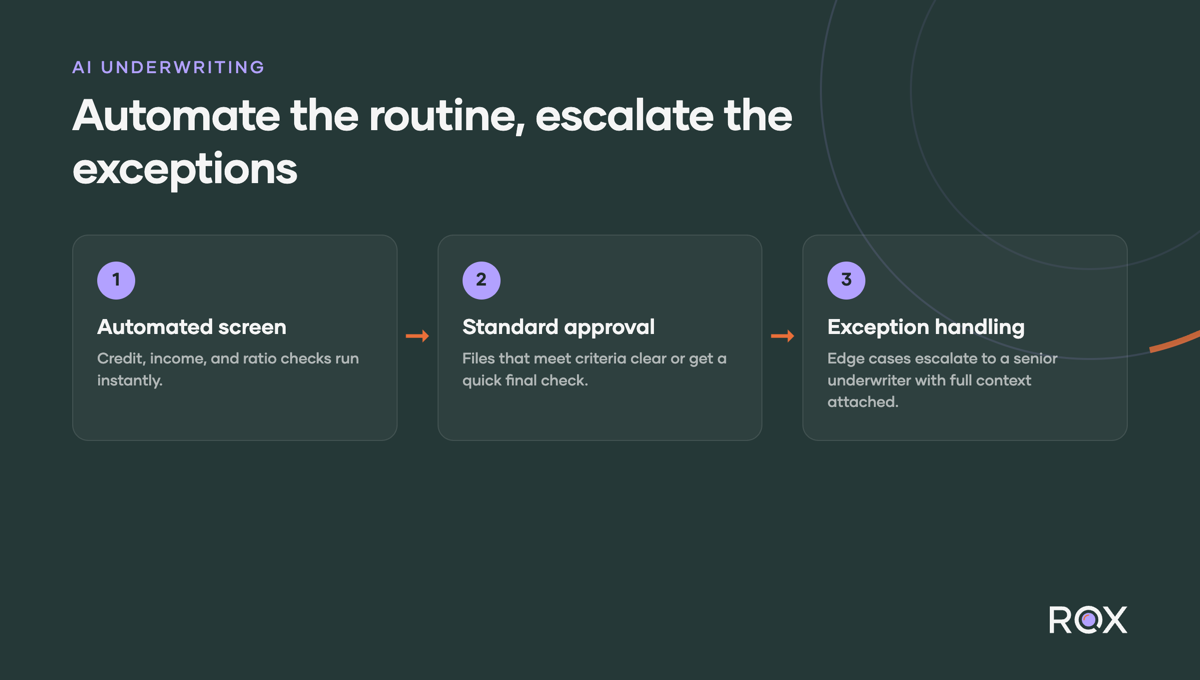
The goal of AI underwriting is not to replace the underwriter. It is to promote them. The durable model lets automation handle the roughly 80% of straightforward decisions while people own the complex, high-value 20%. Feedback loops let underwriters correct the system, which sharpens the model over time and keeps a human accountable when a hard call is made.
Position the technology as a way to remove grunt work, not judgment. When loan officers spend less time on data entry and more on structuring deals, adoption follows.
A phased roadmap to production
Successful rollouts run 12 to 18 months and move in three stages:
- Assessment. Audit your bottlenecks, clean your data pipelines, and establish baseline compliance against NAIC and CFPB standards.
- Pilot. Deploy on a single loan product with heavy human oversight. Run AI and human decisions in parallel to validate accuracy, and conduct fair-lending testing on the pilot group.
- Scale. Expand across products, stand up monitoring dashboards, and set governance for model retraining.
The bottom line
Compliant AI underwriting is not about slowing down. It is about building the guardrails that let you go fast without crashing. The lenders that treat governance as a strategic advantage will capture the faster approvals and the volume growth. Their competitors will be stuck explaining a model they never documented.
See how ROX automates underwriting. Get started free with three free applications. No card, no demo required.
References
- AI in Insurance: How To Build a Compliant Governance Framework — CBH Insights
- When Algorithms Underwrite: Insurance Regulators Demanding Explainable AI Systems — BIPC
- Underwriting Compliance: Modern LOS Features and Automation — DeFi Solutions
- Massachusetts AG Settles Fair Lending Action Based on AI Underwriting Model — CFS Review
- AI Credit Regulations Affecting Lending 2025 — HES FinTech
- The future of AI in the insurance industry — McKinsey & Company